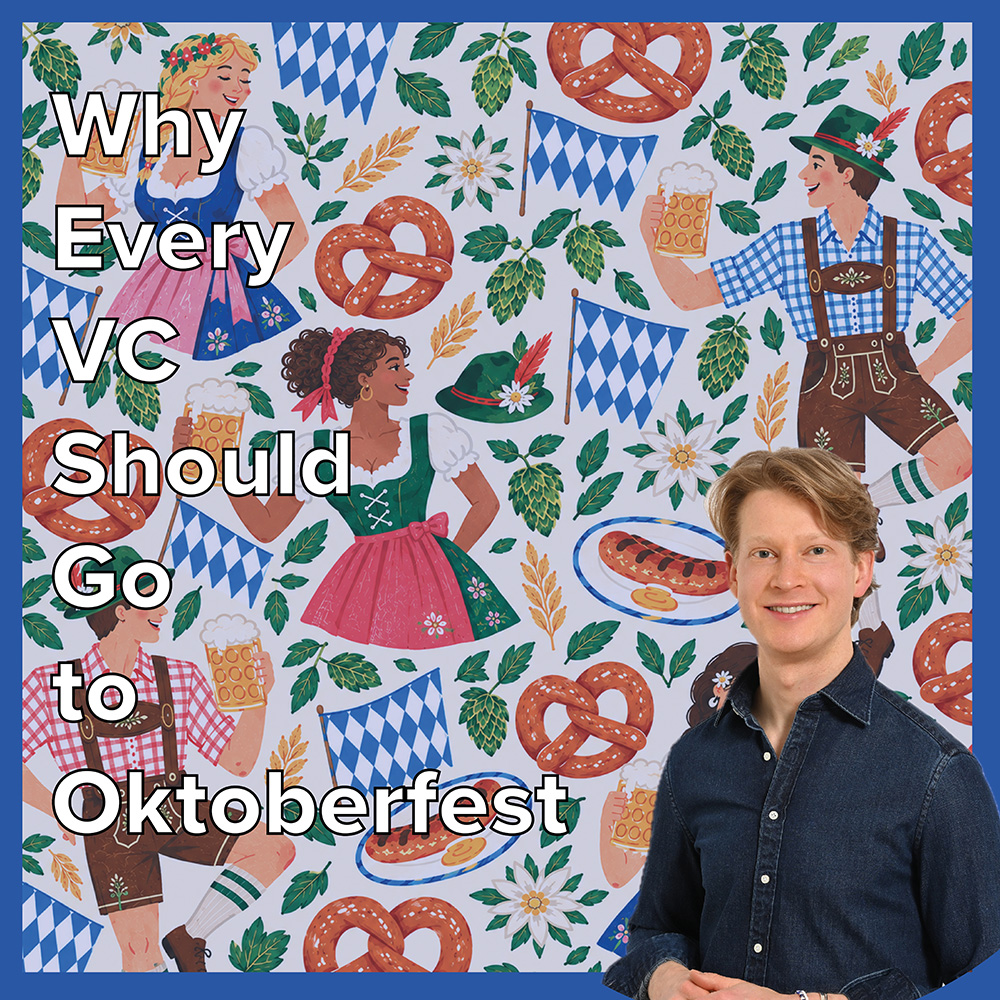

From living in Canada, to investment banking in London, Hamburg-born Philip ‘PK’ Kurzrock brings an international perspective to Endeit’s investment team, while operating from our DACH office back in his home town.
In this conversation, he reflects on the lessons he learned working across finance and private equity, why listening is one of the most important skills in VC, and the opportunities he sees for technology to transform healthcare and improve lives across Europe.
You’ve lived in Canada, Italy and the UK. Did you ever imagine you’d end up back in Hamburg?
Honestly, no. When I left Germany, I thought I probably wouldn’t come back. Life just kept taking me to different places. I moved to Canada quite young, then later studied in Maastricht before doing my master’s at Bocconi in Milan. After that, my career took me to London.
Coming back was never really part of the plan, I'm glad it worked out this way. The city has changed, and so have I, so I get to see it through a different filter now.There’s something special about rediscovering familiar places with a different perspective and a completely different appreciation for what the city has become.
Professionally, it’s exciting too. Having experienced working elsewhere, you come back with a clearer sense of both the challenges, and the opportunities Europe has. The mix of old Hanseatic merchant families and newer tech founders is unusual and an exciting ecosystem to be a part of.
You started your career in investment banking. What drew you into that world?
I love to cook and bake – and I sometimes joke that I couldn’t handle the stress of working in a professional kitchen, so I chose investment banking instead.
Banking was as intense as it was rewarding, especially pre-AI. Looking back, I’m grateful for that. There was no shortcut to the model or the IM. You had to dig deep to get things done and that built grit and endurance that’s hard to come by another way.
People often assume investment banking isn’t creative. But this is where it got me closer to my culinary dreams. I actually think it’s one of the most creative jobs you can imagine. Nobody ever gives you a step-by-step recipe. You get ingredients and a picture of the destination. You know the end point, but the path there is completely unclear. You have to work it out yourself, using logic, creativity and judgement.
You learn 80/20 fast because you have to. And you sit between stakeholders long enough to understand how capital actually moves through a decision.
What did banking teach you that still shapes how you work in venture capital today?
To listen.
Investment banking is an incredible incubator for venture capital. You are put in rooms with people you never thought you would be with at 21: CEOs, CFOs and senior bankers who have been at it for decades. You learn quickly that the value of what you say is almost always less than the value of what you hear – you learn to listen and listen to learn. And in venture capital, that’s one of the most important skills you can have. Good questions follow from careful listening, and in venture, the quality of your questions tends to set the ceiling on the quality of your understanding.
The mentors I learned the most from listened a lot and could reduce complexities into a few first principles – the why, the what, the how. Once those are clear, everything else gets easier to think about.
At what point did venture capital start to feel like the right fit?
Private equity was the bridge. I moved from banking into PE and realised I wanted to be closer to founders and with businesses that were still actively building.
What I love about venture is that you get to invest where value is actually being created. You sit with people forming a view of how the future should look, and you help them get there. That’s a very energising environment to be in.
There’s a German word that feels relevant: Unternehmertum. It translates to entrepreneurialism but it in German it goes beyond that. It’s about autonomy as much as it is about acting with integrity and responsibility for those you are working with. I think venture capital attracts people who really value that mindset.
That being said I'm happy in the supporting role as an investor – being a founder is its own thing, and a hard one, and I have a lot of respect for it from the seat I'min.
What opportunities are exciting you most right now?
I keep coming back to Healthcare.
Europe, like many parts of the world, is dealing with ageing populations, declining birth rates and huge labour shortages across healthcare systems. At the same time, healthcare is deeply tied to the social contract here. Access to good care really matters.
The challenge is obvious: demand is massive, but resources are stretched. The response so far has mostly been to ask clinicians to do more with less. In practice that means more admin and less patient contact. Burnout follows. Waiting times grow.
That’s where technology becomes incredibly interesting. AI and automation can help remove administrative burdens so healthcare professionals can spend more time actually caring for patients, which is what they signed up to do in the first place.
Healthcare is still relatively undisrupted compared to other industries, which means there’s enormous potential to rethink how systems operate and how care is delivered.
Take IVF as one example. It's expensive, emotionally draining, and the success rates still require most patients to go through multiple cycles before, hopefully, a successful pregnancy. Many people who need it simply can't afford it, and there's often very little aftercare or mental health support around the process.
Technology can make treatments like IVF more accessible, more personalised, and more effective. Lower the cost per cycle and you change who can access it,which then changes the size of the market itself.
More broadly, democratising access to healthcare is one of the most important challenges we face. Better healthcare enables people to live longer, healthier lives, and technology can help make those systems more sustainable.
That’s what makes this space so exciting as an investor. As venture capitalists, we get to support founders who are tackling very real societal problems and help them scale solutions that genuinely improve people’s lives.